Dates for Mosques & Community Iftar in Tangerang: A Bulk Procurement Guide
Every Ramadan, hundreds of mosques and prayer halls across Greater Tangerang host communal iftar. For example, Masjid Raya Bintaro Jaya in Tangerang Selatan prepares up to 30,000 iftar portions throughout Ramadan, around 1,000 portions per day (source: Tribun Banten). Across Kota Tangerang and Kabupaten Tangerang, thousands of communities, offices, and iftar committees do the same. Dates are the essential opening dish — in line with the sunnah and practical to distribute.
But procuring dates in large quantities presents its own challenges: how to estimate needs, choose varieties that are economical yet decent, and manage the budget. This guide is written specifically for mosque committees, prayer-hall administrators, cooperatives, and iftar organizers in Tangerang, complete with a portion calculator and variety recommendations.
Why Dates for Breaking Fast
Beginning iftar with dates is a sunnah of the Prophet. There are also strong practical and nutritional reasons:
- Quick energy. The natural sugars in dates (glucose and fructose) restore energy after a full day of fasting.
- Fiber and minerals. Dates provide fiber, potassium, and magnesium that help the body after dehydration.
- Easy to distribute. Dates need no cooking, pack easily per portion, and store well.
- Liked by all ages. Their sweetness is welcomed from children to the elderly.
This is why dates are the most efficient and meaningful iftar component for mass distribution at mosques and communities.
Portion Calculator: How Many Dates Are Needed?
A common benchmark is 3 dates per person (following the tradition of breaking fast with an odd number). One kilogram of dates holds roughly 70–110 pieces depending on variety and size. Here are estimated needs:
| Congregation Size | Pieces (3/person) | Estimated Kg per Day | 30-Day Need |
|---|---|---|---|
| 100 people | 300 pieces | ± 3–4 kg | ± 90–120 kg |
| 300 people | 900 pieces | ± 9–13 kg | ± 270–390 kg |
| 500 people | 1,500 pieces | ± 15–21 kg | ± 450–630 kg |
| 1,000 people | 3,000 pieces | ± 30–43 kg | ± 900–1,290 kg |
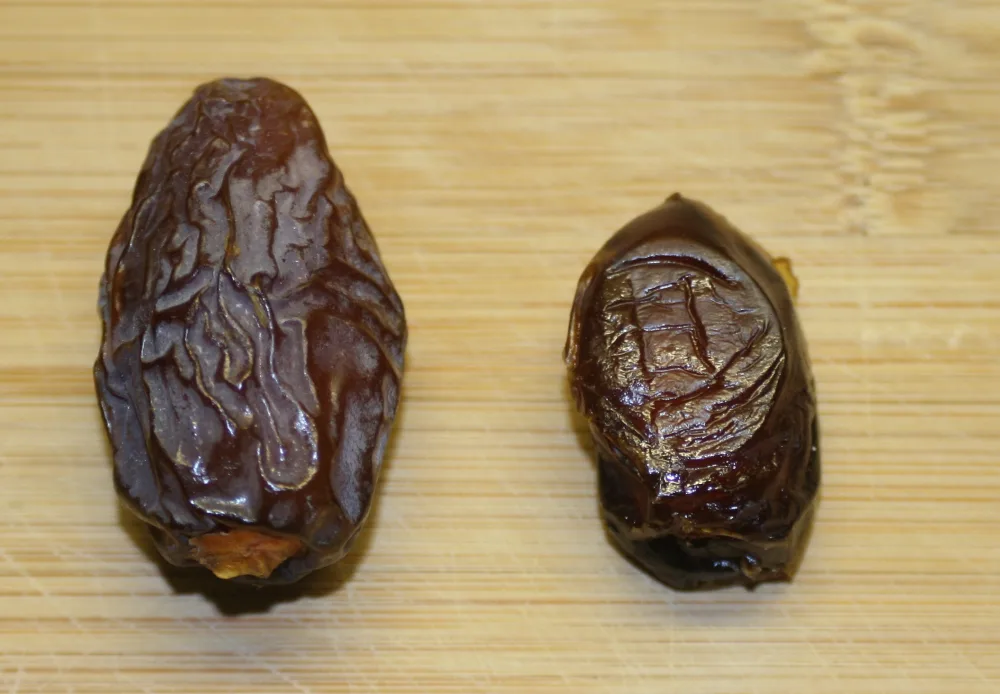
Note: for large dates like Medjool, the piece count per kilogram is lower (around 45–70 pieces), so the kilogram requirement is higher. For mass iftar, medium-sized varieties like Sukari or Khalas are more cost- and quantity-efficient.
Best Varieties for Mosque Iftar
Khalas — Community Favorite
Khalas dates from the UAE (often from Al Foah) are a mosque favorite because they are economical (IDR 45,000–150,000/kg), balanced in sweetness, and not too sticky, making them easy to distribute. This is the top choice for mass iftar on a limited budget.
Sukari — The Best-Seller Everyone Likes
Sukari dates (IDR 60,000–95,000/kg) suit communities wanting slightly higher quality. The texture is soft and moist, the sweetness universal, and the glycemic index is relatively low (around 43.4; sources: hellosehat, Ministry of Health), making them comfortable for congregants of all ages.
Deglet Nour — Semi-Dry Alternative
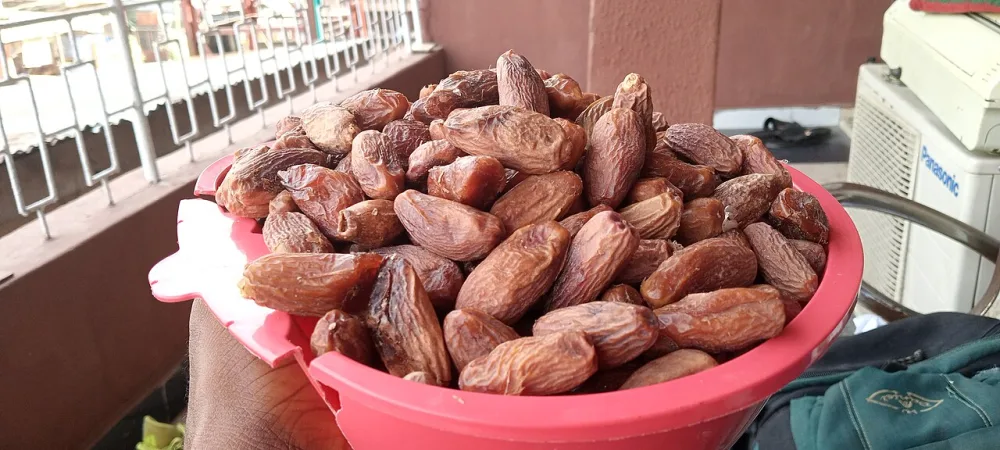
Deglet Nour from Tunisia (IDR 96,000–110,000/kg) has a semi-dry texture, is not sticky, and is very practical to pack per portion since the pieces don't cling together. Ideal for iftar distributed in individual packs.
Tips for Managing the Iftar Procurement Budget
| Strategy | Benefit |
|---|---|
| Buy per 10 kg carton | Per-kg price far cheaper than retail |
| Order early (5 months before Ramadan) | Avoid the 10–25% price rise near Ramadan |
| Choose economical varieties for volume | Khalas/Sukari maximize portions per rupiah |
| Estimate needs accurately | Prevent overstock that risks spoilage |
| Combine purchases across prayer halls | Larger volume unlocks better wholesale pricing |
Given that date demand surges up to 50% during Ramadan and prices climb as the fasting month approaches, early procurement is the most economical strategy for mosque committees (sources: Antaranews, TimesIndonesia).
Order Iftar Dates for Mosques in Tangerang
As a direct importer with over 40 years of sourcing heritage, we serve bulk date procurement for mosques, prayer halls, administrators, cooperatives, and iftar committees across Greater Tangerang — Kota Tangerang, Tangerang Selatan, and Kabupaten Tangerang — as part of our Jabodetabek service area. We supply dates in 10 kg cartons with special volume pricing and can help calculate needs based on congregation size.
Contact WhatsApp +62 823-4350-8579 or email [email protected] for procurement consultation and wholesale quotes. See also our guide on the benefits of dates for breaking fast and suhoor to understand the nutritional value of dates as iftar.
Procurement Logistics: From Ordering to Distribution
Procuring dates for a mosque is not just buying — it is managing a small logistics chain. Here is a flow that helps committees work efficiently:
- Planning (D-60 to D-90). Estimate daily congregation size, choose varieties, and set the budget before prices rise.
- Ordering (D-30 to D-45). Order in carton packaging for efficiency and confirm stock availability from the supplier.
- Storage. Keep dates in a cool, dry place; dried dates last for months, while moist dates need quicker handling.
- Portion packing. For tidy distribution, pack 3 pieces per portion in small containers, especially for semi-dry varieties like Deglet Nour.
- Distribution. Hand out near the Maghrib call to prayer, reserving some for latecomers.
With an organized flow, committees can serve hundreds to thousands of congregants without running short or wasting stock.
The Social and Spiritual Value of Sharing Dates
Beyond logistics, sharing dates at iftar carries deep social and spiritual value. The tradition strengthens brotherhood among congregants, serves as a sustained form of charity, and revives the sunnah of breaking fast with dates. Many mosques across Greater Tangerang, from Bintaro to Cikupa, make their iftar program the center of Ramadan activity, uniting residents across ages and backgrounds. Choosing quality dates for this program is not only about taste, but also a form of respect for the congregants and guests who attend. That is why many committees are now more careful in choosing varieties and ensuring supply from a trusted source.
Pairing Dates with Other Iftar Menu Items
Dates make an ideal opener, but iftar committees often pair them with accompanying items for a more complete break-fast. The classic combination is dates with water or zamzam water, following the break-fast sunnah. For variety, dates can be paired with warm sweet tea, kolak (sweet compote), or porridge. In Tangerang and Banten, local iftar specialties like ketan bintul are also popular alongside dates. For mosques wanting more nutritional value, dates paired with a glass of milk make a good energy-and-protein combination after a full day of fasting. Most importantly, dates remain the core component because they provide quick energy from natural sugars, while other items complement fluids and satiety. This pairing makes the iftar program more satisfying without overburdening the budget.
Note: nutrition information is educational, not medical advice. The 3-piece portion benchmark is general; adjust to your congregation's needs.